
AI platform for employee surveys, assessment & analysis
Employee insight.
AI-assisted analysis.
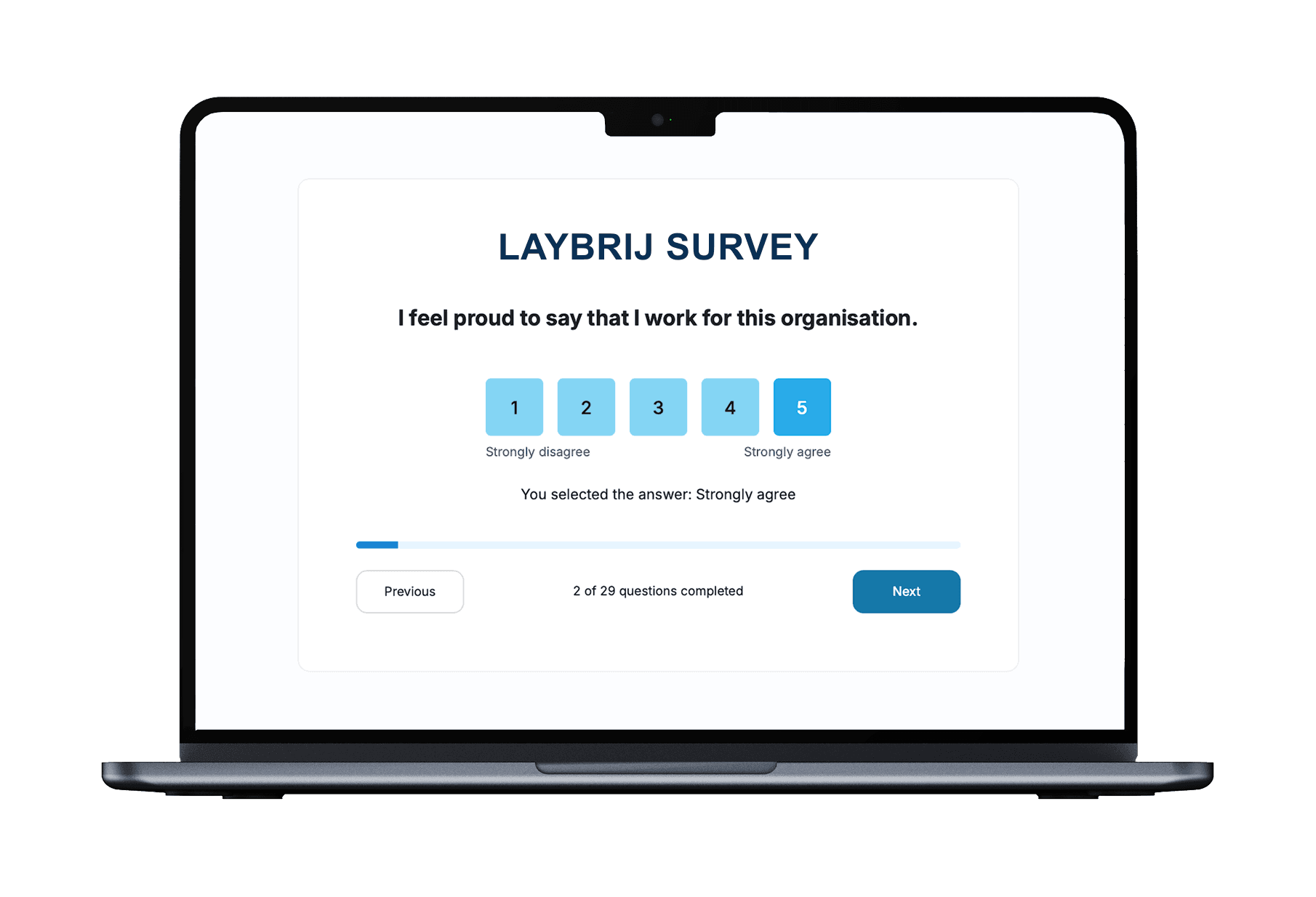
LAYBRIJ SURVEY is an AI platform for employee surveys and assessment, connecting results, organisational health indicators and unit-level reporting. AI-assisted analysis and draft interpretation help your team explore findings and conclusions for human review, not autonomous HR decisions.
External reference materials may describe earlier service packages. Laybrij's current offer on this page is software platform access, not a managed assessment service.
Laybrij provides the software, not assessment or research services. You conduct surveys and assessments independently, or engage an appropriately licensed external organisation to conduct them on your behalf. You are responsible for selecting that organisation and checking its suitability and licensing.
Three formats. One software platform.
LAYBRIJ SURVEY supports eNPS, pulse surveys and 360 feedback as software workflows. Your team or an appropriately licensed third party you appoint operates them; Laybrij does not conduct assessments. Across these formats, AI assists analysis and prepares draft findings for human review. Support for a format does not establish method validity, benchmark comparability or clinical suitability, and outputs must not be used for automated individual employment decisions.
eNPS surveys
Collect a recommendation signal.
Your team or appointed appropriately licensed third party uses the platform to collect employee recommendation responses and review the eNPS result. Under the conventional 0-10 scoring rule, eNPS is the percentage of promoters (9-10) minus the percentage of detractors (0-6), with all valid responses, including passives (7-8), in the denominator. The result is a signed score from -100 to +100, not a percentage or a complete engagement measure.
Pulse surveys
Repeat focused listening.
Your team or appointed appropriately licensed third party uses the platform for short, repeated surveys, choosing the questions, collection windows and review cadence. Review findings in the context of participation and any changes to questions or groups; repetition alone does not make results comparable or validate a method.
360 feedback surveys
Gather multiple working perspectives.
Your team or appointed appropriately licensed third party operates a multi-rater survey workflow for developmental feedback, defining participants, raters, report access and confidentiality rules. AI-assisted analysis and draft findings require human review. This is platform functionality, not an external consulting or assessment service from Laybrij, and not an automated employee ranking or employment decision tool.
LAYBRIJ SURVEY / A Laybrij product showcase
Listen. Understand. Act.
Try the short survey interaction, explore the organisational health dashboard and read an example report fragment. The preview shows how employee input can be presented as indicators, participation patterns and a starting point for management discussion.
01 /Listen
Survey demoEvery voice matters
Question 1 of 3
I feel that my contributions are valued by my manager.
Choose the answer that feels right.
Try it freely. Responses stay in this demo only.
02 /Understand
DashboardsCompany overview
Organisational health
Q2 2026
Health matrix
Participation by department
| Department | Done | Rate |
|---|---|---|
| Operations | 38/45 | 84% |
| Engineering | 41/46 | 89% |
| Support | 29/42 | 69% |
| Finance | 22/28 | 79% |
| Sales | 31/40 | 78% |
| Total | 161/201 | 80% |
Illustrative data only. Not calculated from your demo answers.
03 /Act
Organisational health / Q2 2026
Health indicators
Engagement
Overall index
The willingness to invest personal energy in work and contribute to shared goals.
What the indicators suggest
Engagement is a relative strength. Satisfaction at 62% suggests a closer look at the everyday work experience.
Suggested follow-up
Start with a conversation.
Explore workload and recognition with Support, then agree one practical change to revisit in the next survey.
Interactive illustration with sample data, not a client assessment or a live AI demonstration. Dashboard values are not calculated from your answers. Demo responses stay in this page and are not sent to a server.
The diagnostic view
Five indicators. A more useful conversation.
Read the indicators together rather than treating one headline score as a verdict. Differences between engagement, satisfaction and the other signals help frame questions for further investigation, with participation and reporting context kept in view.
Engagement
Willingness to invest personal energy in work and contribute to shared goals. Read alongside satisfaction to distinguish commitment from a positive view of working conditions alone.
Satisfaction
How employees experience their working environment and everyday conditions. A useful companion to engagement, not a substitute for it or a direct measure of productivity.
Resilience
A diagnostic view of employees' capacity to sustain effort and respond to demands or change. Use it to explore pressure and support, not to diagnose an individual's health.
Clarity
The certainty expressed in survey responses: how definite or ambivalent answers are. Here, Clarity concerns response certainty, not clarity of job roles, responsibilities or organisational strategy.
Loyalty
Employees' expressed relationship with the organisation and willingness to recommend it, interpreted using the scoring method defined for the assessment.
Illustrative values, not actual survey results. Loyalty is shown as eNPS on a −100 to +100 scale, not as a percentage. The other four examples use percentage scores.
The conditions behind the scores
Eight drivers behind the pattern.
Explore the organisational conditions behind the indicators. Driver-level comparisons help leadership and unit managers focus their follow-up on specific areas of work, rather than assume that every team needs the same intervention.
Illustrative scale / 0–100
- LDRLeadership
- Selected unit 72Organisation reference 68
- PRCProcesses
- Selected unit 54Organisation reference 65
- TEAMTeam
- Selected unit 81Organisation reference 74
- STRStrategy
- Selected unit 66Organisation reference 69
- REWReward
- Selected unit 48Organisation reference 61
- CLTCulture
- Selected unit 75Organisation reference 71
- INNInnovation
- Selected unit 63Organisation reference 60
- COMCommunication
- Selected unit 58Organisation reference 67
Illustrative data only. These invented values and the 0–100 scale demonstrate comparison, not actual survey results, benchmarks or a confirmed scoring method. Differences invite discussion, not a verdict.
Comparison updated: OperationsDesigned around responsibility
Different responsibilities. Connected insight.
Executive
Set the priorities that need leadership ownership.
Use the organisation-level view and strategic narrative report to discuss cross-functional patterns, challenge assumptions and decide which issues require executive attention. Agree sponsors and priorities rather than delegate every finding to HR.
HR
Coordinate the diagnostic and the follow-through.
Review participation, compare eligible units and help managers interpret findings in context. Coordinate communications, reporting access and action-planning support, then organise follow-up against agreed priorities.
Unit manager
Turn local findings into a team discussion.
Review the results available for your unit, explore relevant driver differences with the team and agree practical actions within your authority. Assign responsibility and a review point, escalating issues that need organisation-wide decisions.
Participation & governance
Participation depends on clear boundaries.
Define how feedback will be handled before inviting employees to participate. Confidentiality safeguards, reporting rules and access permissions should be understood by participants and agreed with the organisation for the project.
Confidentiality and reporting thresholds
Use minimum reporting thresholds to limit exposure in small teams or sensitive groups. Agree how small-group results and open-text comments will be handled and explain the safeguards and their limits; confidentiality is not a blanket guarantee that identification is impossible.
Access matched to responsibility
Role-based access separates executive, HR and manager reporting needs. Agree who can see each organisational level and which reports they receive, rather than assume every administrator or manager can access all feedback.
Deployment and data handling scoped per project
Confirm hosting, data location, permitted processing, retention and deletion arrangements during scoping. Review applicable organisational and jurisdictional requirements for the proposed deployment; these must not be inferred from a general product page or treated as compliance certification.
Self-service platform workflow
Your assessment. Your platform workflow.
Your team, or the appropriately licensed organisation you appoint, uses the platform through four stages. You set the schedule, collection window and responsibilities to suit your organisation. These are software-use steps, not a Laybrij service delivery plan.
- Stage 1
Setup and mapping
Configure your project, map the organisational hierarchy and prepare participant communications. Define reporting groups, access responsibilities and data-handling arrangements before launch.
- Stage 2
Data collection
Launch your survey through channels such as email, SMS or QR codes. Monitor participation in the platform during the collection window you set, and manage your participant communications.
- Stage 3
AI-assisted analysis and review
Explore indicator and driver patterns and compare reportable units. Review AI-assisted analysis and draft interpretation against the results and organisational context before accepting any conclusions.
- Stage 4
Results and follow-up
Use role-based dashboards and reports to share reviewed findings with authorised colleagues. Your organisation decides what to do next, assigns ownership and reviews progress; the platform does not make HR decisions for you.
Software licensing
Annual software access.
License the platform for your organisation's own use or use by an appropriately licensed organisation you appoint. Pricing is confirmed by quote, based on participant numbers and deployment requirements; assessment and research services are not included.
Annual licence
Per-participant model
An annual software licence priced per participant for surveys, assessment and analysis. Confirm participant coverage, deployment requirements and the final commercial scope in your quote.
- Full platform access
- Unlimited administrators, with role-based permissions
- Standard reporting
- Hosting included within the agreed deployment scope
FAQ / LAYBRIJ SURVEY
Questions about LAYBRIJ SURVEY
How is LAYBRIJ SURVEY licensed?
LAYBRIJ SURVEY uses an annual, per-participant software licence model, with platform access, unlimited administrators with role-based permissions, standard reporting and hosting within the agreed deployment scope. Request a quote to confirm coverage and terms. Laybrij does not conduct assessments or research; you run them independently or appoint an appropriately licensed organisation, whose selection and licensing checks remain your responsibility.
What needs to be agreed before launch?
Start with the participant population, organisational hierarchy, reporting groups and communication plan. Confirm project responsibilities, role-based access, reporting thresholds and data-handling requirements. These decisions shape configuration and help employees understand how their feedback will be used.
How is employee confidentiality handled?
The approach includes confidentiality safeguards, minimum reporting thresholds and role-based access. The project must define how small groups, comments, hosting and data retention are handled, and explain the limits to participants. Do not assume absolute anonymity or automatic regulatory compliance from the product description.
Who sets the schedule and reviews AI-assisted conclusions?
You or your appointed organisation set the schedule for setup, collection, analysis and follow-up. There is no fixed delivery deadline. AI-assisted analysis and draft interpretation require human review in context; your organisation remains responsible for conclusions and decisions, including any HR action.
Demo & platform access
Explore the platform for your organisation.
Request a demo or discuss software access for your participant population, reporting needs and deployment requirements. Laybrij supplies the platform; your organisation or its appointed licensed provider conducts the assessment.